The filter era is over. The scene era started.
The short version: a filter edits the photograph. It shifts colour and contrast, and everything that was in the frame stays in the frame. What replaced it edits the event — the outfit, the room, the whole situation are now variables. That's a genuine break, not an upgrade, and it changes what a photo is implicitly claiming about the moment it came from.
What a filter could never do
From roughly 2010 to the early 2020s, photo editing on a phone meant one thing: a transformation applied to pixels without any understanding of them. Warmer, cooler, more contrast, fade the blacks, add grain. Every filter in that era shared a hard limit — the content was fixed. You could make your kitchen look like a Kodak kitchen. You could not make it not be your kitchen.
That limit did quiet work. It meant a photo, however heavily processed, was still evidence of a place you stood in wearing clothes you owned. The edit was cosmetic, and everyone understood the contract.
What changed
Models that can segment a scene broke the contract. Once software can tell which pixels are a face, which are a sweater and which are a window, the sweater and the window become editable independently of the face. The photograph stops being a fixed record with adjustable colour and becomes a set of components, most of which are now optional.
The interesting part isn't that this is possible. It's that it collapsed the cost. Compositing yourself onto a rooftop in Marrakech was possible in 2005 — it took a professional several hours. Now it takes twenty seconds and no skill, and things that become free get done constantly.
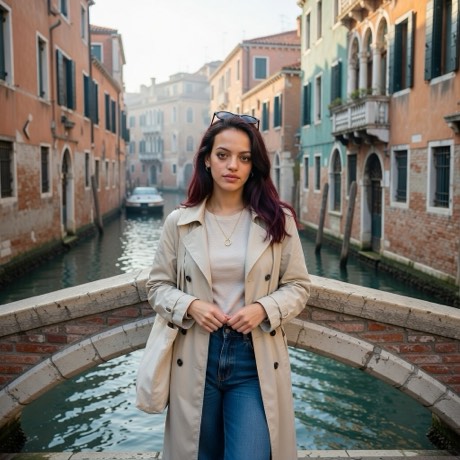



Same sofa, four continents.
Two different claims
It's worth being precise about what each kind of edit asserts.
A graded photo says: this happened, and here's how it felt. The colour is interpretation laid over a real event. Nobody has ever thought a warm filter was a lie.
A scene-replaced photo says something else, and what it says depends entirely on framing. Posted plainly, it implies you were somewhere you weren't. Posted as what it is — obvious transformation, recognisable as an image made rather than captured — it's costume, and costume has never needed a disclaimer.
The failure mode isn't the technology. It's presenting the second thing as the first.
Why the obviously-fake ones are the healthy ones
There's a reason the most popular looks in this category tend to be the ones nobody could mistake for photographs. Turning yourself into a cel-animated character, a clay puppet or a pixel sprite carries zero implication of having been anywhere. The transformation is the point and it's legible to everyone who sees it.
The uncomfortable zone is photorealistic scene replacement — you, plausibly lit, in a place you've never been, looking exactly like a photograph. It's also the most technically impressive output the category produces. Both things are true.
What this does to the photo you started with
Here's the part that surprised us building this. When the scene became editable, the value of the original photo went up, not down.
Everything downstream depends on the input — your face has to be readable, the light has to have direction, the frame has to have room. A carelessly taken photo produces a bad transformation of a bad photo. So the skill that matters hasn't been automated away; it's just moved. It used to be "take a good photograph." Now it's "take a photograph good enough to be transformed," which is nearly the same discipline.
Where this settles
Probably where costume always settles. People will use the obviously-transformed looks constantly and casually, because they're fun and they read as fun. Photorealistic relocation will stay slightly awkward, get used anyway, and be judged by context rather than by rule — the same way nobody objects to a heavily staged holiday photo but everybody notices a fake one.
What won't come back is the old contract, where a photo on a phone was a lightly-graded record of an event. That era ended quietly, and mostly people just enjoyed the new thing.
Same sofa. Different continent.
Twelve locations, and forty more looks that make no claim at all.
Download on theApp StoreFree to download · iPhone · iOS 17+