What “it still looks like you” actually means
The short version: recognition runs on structure, not detail. The distances between your features, the width-to-height ratio of your face, your hairline and your silhouette are what identify you — not skin texture or how sharply your eyes are rendered. That's why heavy stylisation can preserve identity perfectly while a gentle, photorealistic edit can quietly destroy it.
The thing that seems backwards
Run one photo through a pixel-art style that reduces your face to a few dozen coloured squares. It's still obviously you. Run the same photo through a soft, photorealistic "enhancement" that smooths your skin and opens your eyes slightly. Something is off, and you might not be able to say what.
That's not a quirk of one app. It's how human face recognition works, and it has a fairly well-understood shape.
Configural information beats featural information
Face perception researchers draw a distinction between featural information — the individual parts, the shape of a nose, the colour of an iris — and configural information, which is the spatial relationships between those parts.
Configural information does most of the work. The distance between your pupils relative to the width of your face. Where your eyes sit vertically in your head. The distance from nose to mouth. Your jaw's width against your cheekbones. Your hairline's shape.
These are ratios, and ratios survive brutal compression. Reduce a face to a 32-pixel grid and the ratios are still roughly there — which is why the pixel portrait works. Change the ratios by a few percent while keeping every detail crisp, and recognition degrades even though nothing looks obviously wrong.

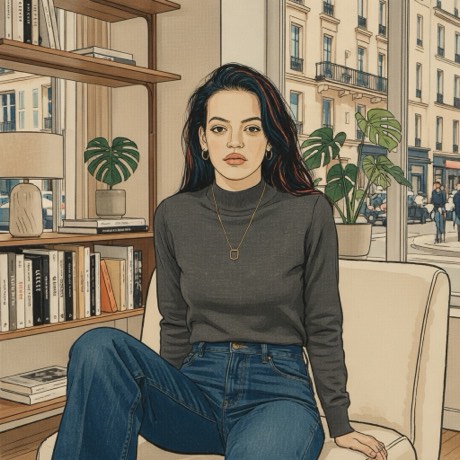

All four throw away enormous amounts of detail. None of them throws away the proportions.
Why "beautify" is the riskiest style there is
Almost every subtle enhancement moves configural information, because the things people find flattering are drifts toward a population average: eyes slightly larger and more symmetrical, jaw slightly narrower, face slightly more symmetric, nose slightly smaller.
Every one of those is a ratio change. Applied lightly, you get the uncanny result of a photo that is unmistakably a person, plausibly you, and somehow not. It's the same mechanism that makes a whole group of people processed through the same beauty filter start to look related — they've all been moved toward the same average, and the average is where identity goes to die.
The strongly stylised looks are, counterintuitively, the safe ones. A cel-animated version of you isn't trying to make you more attractive; it's translating you into a different medium and keeping the geometry.
What this means for choosing a photo
If configural information is what has to survive, then the input's job is to make that information legible:
- Front-on beats angled. A face turned away compresses the horizontal ratios — and the model has to guess them rather than read them. This is the biggest single factor.
- Directional light beats flat light. Shadow reveals structure. A flatly-lit face hides the very cheekbone and jaw geometry that identifies it.
- Hair matters more than you think. In heavily reduced styles, silhouette is doing most of the identification. A hat or a hood removes a large chunk of your identity signal.
- Resolution matters less than you think. A slightly soft front-on photo outperforms a razor-sharp profile.
How to judge a result honestly
Don't ask whether you like the image. Ask a narrower question: would someone who knows me pick this out as me, quickly, without being told?
Two practical tests. First, shrink it — identity that survives at thumbnail size is carried by structure, which is the durable kind. Second, put it beside the original and look specifically at the spacing between your eyes and the width of your jaw, not at how good your skin looks. That's where the drift hides.
The same test decides whether something works as a profile picture, which is the most demanding case there is — recognition, instantly, at forty pixels, by people scrolling fast.
The short of it
Detail is what a style changes. Proportion is what identity is made of. Any tool that respects the second can take enormous liberties with the first — and the styles that look like they'd destroy your likeness usually don't, while the ones that look harmless sometimes do.
Run the test on your own face
Try a heavy style and a gentle one on the same photo. The result will surprise you.
Download on theApp StoreFree to download · iPhone · iOS 17+