What’s actually inside a look
The short version: a look in Pose AI isn’t a set of slider values. It’s a short written brief, and every brief does the same four jobs: it names a reference the model already knows, describes the physical details that make that reference recognisable, says what has to stay the same, and says what must not appear. Specific photographic language works far better than mood words like “cinematic” or “dreamy”. A better brief still can’t fix hands, lettering, crowded group shots or a face turned away from the camera.
You tap a tile called Golden Hour and twenty seconds later your kitchen is lit like late afternoon. It’s easy to assume there’s a dial somewhere behind that tile: warmth up, shadows lifted, a bit of grain. That’s how filters worked for fifteen years.
There is no dial. Behind every tile is a paragraph of plain English, written the way a photographer would brief a lighting assistant. The model reads that paragraph alongside your photo and builds a new picture to match both. Knowing what’s in the paragraph explains most of what you see come back, including the misses.
A filter has settings. A look has a brief.
A filter can only do what its settings describe, and its settings can only describe colour and tone. A brief can describe anything a sentence can: a light source, a fabric, a room, a mood, a camera, a decade. That’s why the same mechanism can produce a colour grade, a clay puppet and a night train. The difference between those looks isn’t a different tool. It’s different words.
The flip side is that words are imprecise in ways numbers aren’t. A brief has to be written so the model can’t misread it, and most of the work in a good look is closing off the wrong readings.
The four jobs every brief does
1. Name a reference. The fastest way to describe a look is to name something the model has already seen thousands of times: a particular film stock, a type of light, a decade, a printing method. One name carries a whole cluster of detail, the colour of the shadows, the texture of the grain, the clothes people wore. A look called Film Noir doesn’t ask for “black and white”. It names a specific kind of black-and-white film with strong midtone contrast.
2. Describe the physical evidence. A name alone is a hint. The details are what make the result read as the real thing. The Split Light look doesn’t just say “dramatic”. It asks for a single source directly to one side, exactly half the face lit, and a crisp vertical line where light meets shadow. Stop Motion asks for thumbprints in the clay, a faint seam along the jaw and stitched felt clothes. These are the things your eye uses to recognise a medium, so they’re the things the brief spells out.
3. Say what stays. Most Restyle briefs end the same way: keep the exact same pose, scene and framing, and keep the likeness. That sentence is the whole difference between a lighting change and a new photo. Reimagine briefs do the opposite. They name a specific new scene, an outfit and something to be doing, like sitting by the window of a sleeper carriage with a blanket over your knees, and hold on to only your face. The two modes are explained in how to restyle a photo with AI.
4. Say what must not appear. Many briefs end with a list of exclusions: no text, no lettering, no signage, no brand logos. That line exists because generated lettering comes out as convincing nonsense. A look that invents a street full of shop signs will fill them with words that aren’t words, so the brief asks for a street without them.
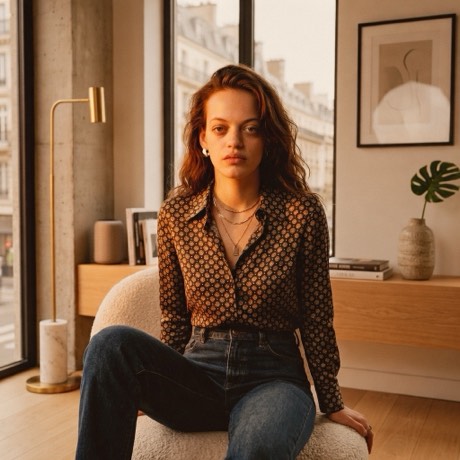
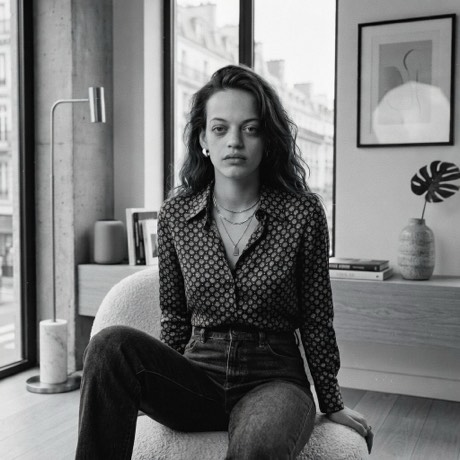
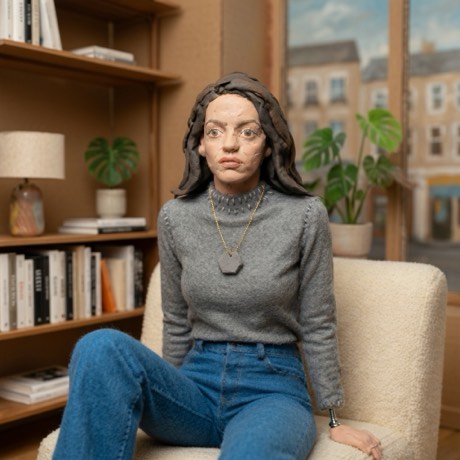
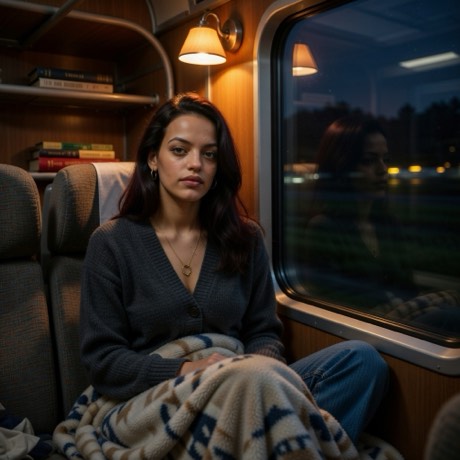
Same photograph, four briefs. The first two hold the scene and change the light. The third changes the medium. The fourth throws the room away.
When a brief contradicts itself, the model takes the easy half
The most common way a look fails isn’t that the model ignores the brief. It’s that the brief asks for two things that can’t both happen, and the model quietly picks the easier one.
An earlier version of the Grand Hotel look asked for a pastel, perfectly symmetrical room and also said to keep the exact same scene. Those two instructions fight. The model kept the scene and skipped the style, and the result was the original photo with a faint warm tint. The fix was to say plainly that the whole room gets repainted and redressed, and that only the pose and framing are held.
Stop Motion had the same problem from the other side. Asking for “a clay puppet, keep the room” was too soft, and the photo came back nearly untouched. The current brief states the medium first, rules out photorealism outright, and lists the handmade details that make clay read as clay.
Both fixes point the same way. When a model has an easy option, it takes it. A brief has to make the easy option unavailable.
Why “make it cinematic” doesn’t get you there
This is the practical reason a library of written looks beats typing your own request. “Cinematic” is a word with no evidence attached. It doesn’t say where the light is, what the shadows are doing, what the grain looks like or what era the clothes come from, so the model fills each gap with its average answer. The average of every cinematic image is a slightly teal, slightly orange, slightly blurry photo, which is exactly what you get.
A brief that names a tungsten night film, a blue-green cast in the shadows and a glow around the brightest lights leaves much less to fill in. What makes a still read as film in the first place is covered in the cinematic photo filter guide, and the same logic applies to noir: the look is in the light, not the label.
What no brief can fix
Careful wording narrows what the model can get wrong. It doesn’t remove the hard cases. Hands still come back with the wrong number of fingers. The no-lettering line cuts down on fake signs, but any text that does appear still won’t spell anything. Every extra face in a group shot is another chance for one likeness to drift. A face in full profile gives the model too little to hold on to, and no sentence about likeness changes that.
Those are input problems, and they’re covered properly in the photos none of these looks will save. A brief also can’t make two runs identical, which is a feature more than a flaw: see why the same photo never comes back the same twice.
The short of it
A look is a few sentences doing four jobs: name it, describe the evidence, say what stays, say what can’t appear. When a result surprises you, it’s usually one of those four doing more or less than you expected. Pick the look whose brief matches what you want changed, and give it a photo it can work with.
Every look is already written.
Pick one, tap the shutter, keep the frame you like.
Download on theApp StoreFree to download · iPhone · iOS 17+