Restyle keeps your pose. That makes the pose your job.
The short version: every Restyle look is told to keep your exact pose, camera angle and framing, and to change everything else: the colour, the light, the medium. So the pose is the one decision that survives every look, and you make it before you press the shutter. Reimagine works the other way round. It is told to change your pose along with the room and the clothes, and to keep only your face. Pose on purpose for Restyle. For Reimagine, give it a clear, well-lit face and let the pose go.
Most people take the photo quickly and spend their attention on picking the look. That’s backwards for half the app. In Restyle, the look decides how the picture is drawn, lit and coloured. It doesn’t decide where your arms are, which way your head is turned or how high the camera was. Those are already in the photo, and the look is instructed to leave them alone.
Which means a stiff, awkward pose comes back as a stiff, awkward pose in pencil. Then again as a stiff, awkward pose in comic-book ink. The style changes. The awkwardness is the part that stays.
What each mode does with your body
Every look in the app is a short written brief (what goes into one), and the mode adds a line in front of it.
Restyle adds: keep the same camera angle, framing and composition. Nearly every Restyle brief then repeats it in its own words: keep the exact same pose, scene and framing. Your room stays, your clothes stay, your body stays where it was. What changes is the treatment on top.
Reimagine adds the opposite: replace the whole scene, change the pose, the clothing and the setting, keep only the face and identity recognisable. The model chooses a new pose to suit the new place. That’s why a Reimagine result can put you on a train with a blanket over your knees when you were sitting upright in an armchair.
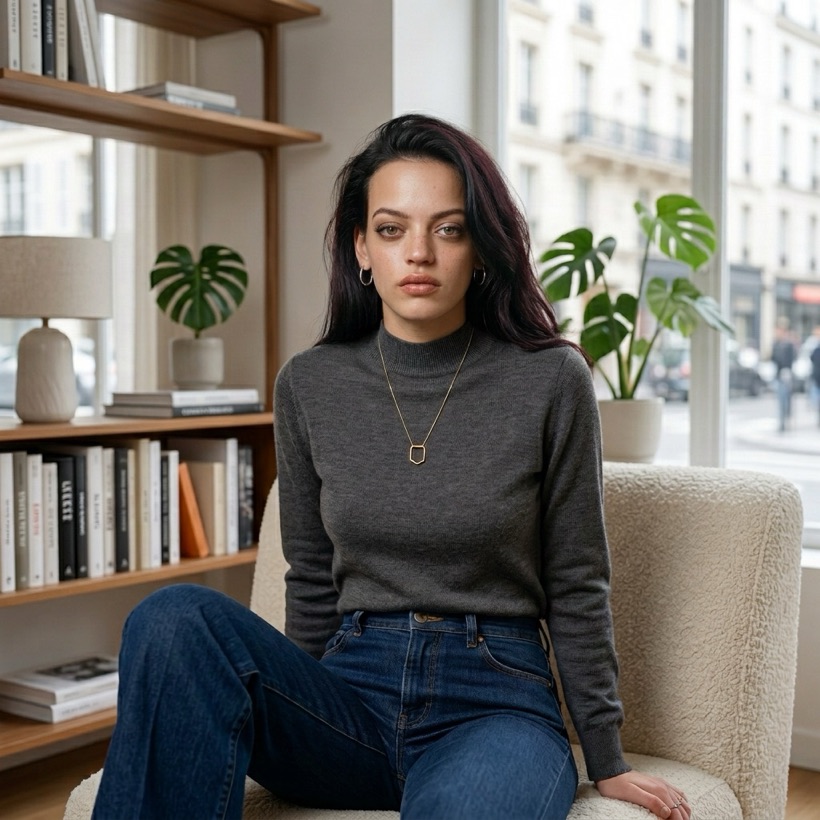
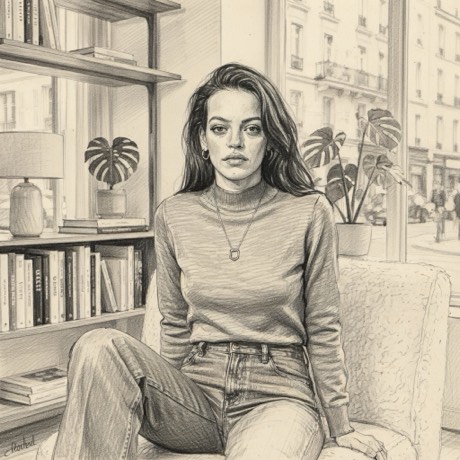
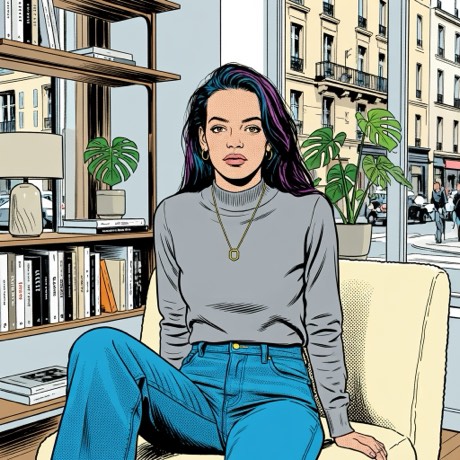
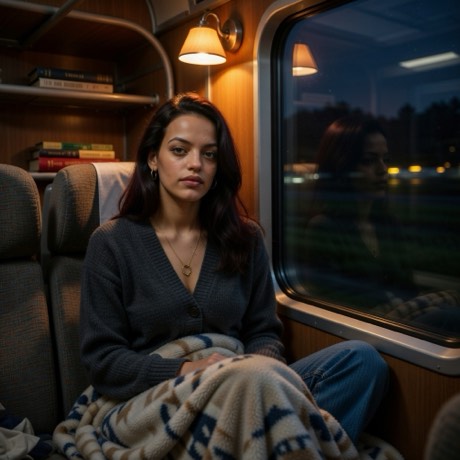
Two Restyle looks keep the chair and the pose. The Reimagine look on the right keeps the face and moves everything else.
Posing for Restyle
The useful question is not “does this pose look good?” but “will this pose still read when the photo is redrawn as flat colour, ink lines or pencil strokes?” A few things decide that.
Face the camera, or nearly. Likeness depends on the model being able to read the proportions of your face, and a face turned well away hides them. Front-on or a slight angle does more for the result than any other choice (why front-on wins). In Restyle this is permanent: the look won’t turn your head for you.
Give your hands somewhere simple to be. Hands are still the weakest part of generated images, and Restyle redraws them in place, so a complicated gesture gets redrawn as a complicated gesture with more chances to go wrong. Hands in your lap, at your sides, in pockets or resting on a chair arm are safe. Hands near your face, fingers spread or holding something small are where you should expect to look closely (the full list of weak spots).
Make a clear shape. The heavier looks reduce a photo to outlines and flat areas. Comic Book, Woodblock and Pixel keep very little of the original texture, so the outline of your body carries more of the picture than it did in the photo. Arms folded tight against a dark top can merge into one block. A little space between your arms and your body, or a lighter layer over a darker one, keeps the shape readable once the detail is gone.
Put the camera where you want it. Restyle keeps the camera angle, and the camera angle is a big part of how a photo feels. The held-out phone above eye level is the most recognisable angle there is, and no look disguises it. If you want something that reads as a portrait rather than a selfie, prop the phone at chest or eye height, or hand it to someone.
Frame for the look you want. Restyle won’t widen the shot. A tight crop stays a tight crop, so if you want your outfit or the room in the final image, step back before you shoot.
Hold the expression. The look keeps your expression along with everything else. A face caught mid-word or mid-blink gets faithfully redrawn mid-word or mid-blink. Settle the face, then take it.
Posing for Reimagine
Here the advice mostly flips. The pose you hold in your kitchen isn’t coming with you to the rooftop, the ski lodge or the night train, because the brief tells the model to change it. Effort spent on a dramatic pose is largely wasted.
What does carry over is your face, so that’s where the effort should go: a clear, front-on face in decent directional light, one person in frame, nothing covering your hair or jaw. A calm, ordinary portrait is a better Reimagine input than a striking pose with your face half turned.
The honest cost is that you can’t direct the new pose. If you hate the way you’ve been placed, the only lever is to run the look again, and each run lands somewhere different (why that happens). If the pose itself matters to you, that’s a sign you wanted Restyle. The guide to the two modes covers which one fits which photo.
Where “keep the pose” slips
Keeping the pose is an instruction, not a guarantee. A model redraws the whole image every time, so small things move even when it’s trying not to. Fingers get re-drawn and sometimes rearranged. A shoulder sits a little differently. Hair falls a different way. You won’t get a pixel-for-pixel match, just the same gesture.
Some looks bend the rule by design. Rubber Hose asks for bendy limbs with no visible joints, so your elbows will go. Stop Motion turns you into a clay puppet with a larger head on a smaller body. The pose survives in spirit, the proportions don’t. And the drawn looks, like anime and cartoon, simplify faces and bodies as part of the style, which can soften a subtle pose into a more generic one.
The short of it
In Restyle, the look handles the colour, the light and the medium, and leaves your body exactly where you put it. So put it somewhere good: face the camera, keep your hands simple, leave a clear outline, choose the camera height and the framing on purpose. In Reimagine, stop posing and give it a good face. The app has the word “pose” in its name, but only one of its two modes actually lets you keep yours.
Strike it once. Keep it in every look.
Take the photo, pick a look, keep the frame you like.

Free to download · iPhone · iOS 17+